
Android Earthquake Alerts Now Cover 200+ Regions, Up From 98
Google has expanded Android's Earthquake Alerts System from 98 to over 200 countries and regions, adding more detailed warnings after sending a billion alerts since 2021.
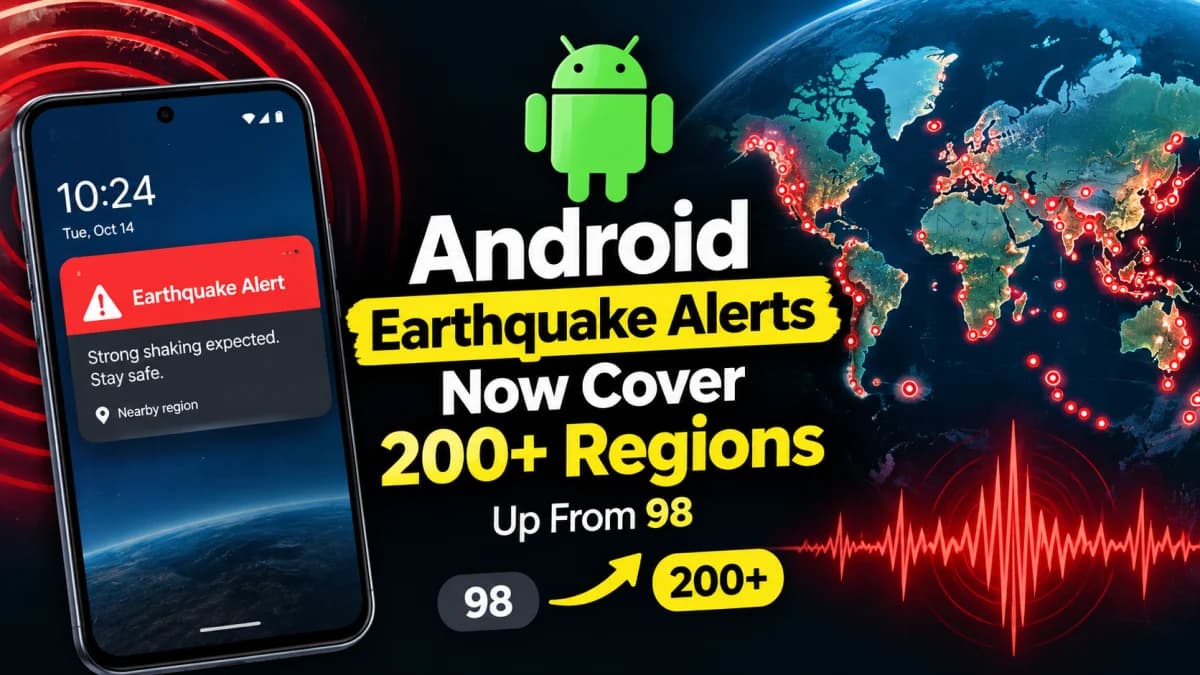
Google has expanded its Android Earthquake Alerts System to more than 200 countries and regions, more than doubling its previous coverage of 98, while also adding more detailed warnings for users in affected areas.
What's Changing
Google announced the expansion in a blog post on October 15, confirming new regions including Panama and Guatemala, though the company hadn't yet published a full list of all newly covered areas at the time of the announcement. The new coverage began rolling out the same day and is expected to reach all newly supported regions over the following week.
Alongside the wider rollout, Google is also improving its "Be Ready" alert, the mid-tier warning level, to show more information in seconds: a map of the affected area, an estimated magnitude, and clearer guidance on what to do. Google says this update will arrive "in the coming months."
How the System Actually Works
Android Earthquake Alerts, first launched in 2021, turns ordinary Android phones into a distributed network of seismometers. Every Android phone already has an accelerometer, the same sensor that detects screen rotation, and when enough nearby phones detect earthquake-like shaking at the same time, that data gets sent to Google's servers, which estimate the earthquake's location and strength and push alerts to phones in the surrounding area.
Depending on estimated shaking intensity, users receive one of three alert levels:
- Be Aware: for light shaking
- Be Ready: for stronger tremors, soon to include a map and safety guidance
- Take Action: for severe shaking, where every second of advance warning matters
The system builds on research published in Science in 2025, which detailed how Android's global smartphone network can function as an earthquake detection and early-warning system even in regions without traditional seismic infrastructure.
Alerts are enabled by default on supported Android phones, though users can turn them off in Safety and Emergency settings if they choose.
A Billion Alerts and Counting
Google says it has sent more than one billion individual earthquake alerts since the system launched in 2021. The company has been expanding coverage steadily: California was first, using the existing USGS ShakeAlert network rather than Android phones alone, India joined in 2023, and all 50 US states plus six territories were added in 2024.
The Venezuela Connection
Google specifically pointed to Venezuela's back-to-back major earthquakes in June 2026 as a case where the system made a real difference. While the quakes were still devastating, user reports indicated that at least some people received alerts in time to seek safety before the shaking reached them.
Google CEO Sundar Pichai highlighted this example in discussing the system's expansion, framing it as evidence of the value of extending early-warning coverage to regions that often lack dedicated seismic monitoring infrastructure of their own, exactly the gap crowdsourced, phone-based detection is designed to fill.
Why This Matters
Earthquake early warning doesn't stop earthquakes, but even a few seconds of notice can be the difference between standing exposed and taking cover, or between driving on a highway and pulling over safely. For much of the world, especially lower-income and earthquake-prone regions that have never had dedicated seismic networks, a system built entirely on phones people already own is a meaningfully cheaper and faster path to that warning than building traditional infrastructure from scratch.
Frequently Asked Questions
How many regions does Android Earthquake Alerts now cover? More than 200 countries and regions, up from 98 previously.
Do I need to do anything to get earthquake alerts? No. The feature is enabled by default on supported Android phones. You can check or adjust it in Safety and Emergency settings.
How does my phone detect an earthquake? It uses the phone's built-in accelerometer. When enough nearby phones detect similar shaking at the same time, Google's servers estimate the earthquake's location and magnitude and send alerts to the area.
Did this system actually help anyone? Google points to Venezuela's June 2026 earthquakes as an example where user reports suggest the alerts gave people enough warning to seek safety.
Bottom Line
By turning phones people already carry into a global seismic network, Google has built an early-warning system that reaches far more of the world, far faster, than traditional infrastructure ever could. Expanding from 98 to over 200 regions brings that protection to a huge number of new users, many in places that previously had no earthquake warning system at all.
Sources: Google (official blog), Android Authority, Digital Trends, Sammy Fans. Information is accurate as of October 15, 2026.
Stay ahead of artificial intelligence & systems code.
One email a week with the biggest AI and dev news. No spam. Unsubscribe anytime.