
ChatGPT Ads Are Evolving: Sponsored Agents, an AI Ads Manager, and Growing Questions About Trust
OpenAI began testing ads in ChatGPT in February. Now it is trialing Sponsored Agents and an Ads Manager plugin, while restricting ads from rival image and voice AI tools.
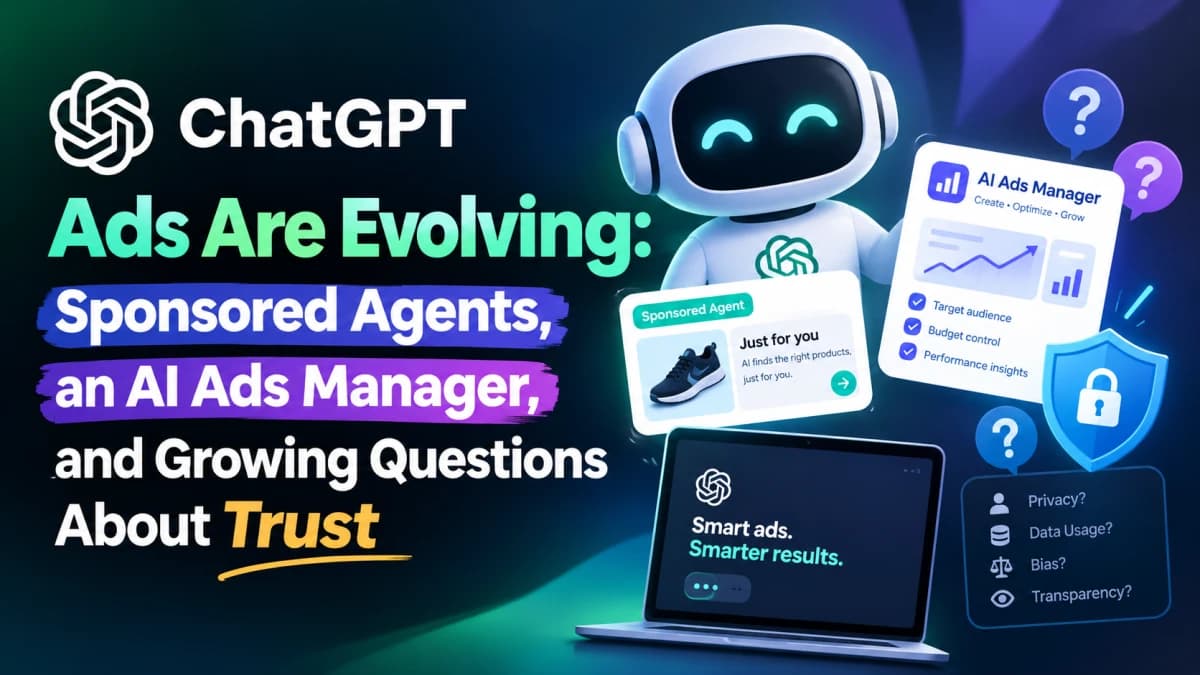
OpenAI's experiment with advertising inside ChatGPT is moving from a simple banner-style test to something much bigger. Over the past few weeks the company has added AI-powered ad tools, started testing a new "Sponsored Agents" format, and quietly changed which companies are allowed to advertise.
How ChatGPT Ads Started
OpenAI first outlined its advertising principles in January 2026 and began testing ads on February 9, 2026. The test is limited to logged-in adult users in the United States on the Free tier and the low-cost Go tier. Plus, Pro, Business, Enterprise and Education accounts are excluded.
Ads appear below some responses and are labeled "Sponsored" so they stay visually separate from ChatGPT's answers. OpenAI says ads do not influence what the model says, and that advertisers cannot shape or rank its responses.
What Advertisers Can and Can't See
OpenAI says advertisers do not get access to user chats, chat history, memories or personal details. They only receive aggregate performance data, such as how many people viewed or clicked an ad. Users under 18 are not shown ads during testing.
Users also get controls: they can dismiss an ad, give feedback, see why they were shown it, delete ad data and manage personalization.
What's New: Sponsored Agents and AI Ad Tools
On September 16, 2026, OpenAI began testing Sponsored Agents with a small group of US advertisers. It also began rolling out three tools for advertisers:
- An Ads Manager plugin inside ChatGPT, so advertisers can create, update and analyze campaigns using plain-language prompts.
- Suggested ad copy and imagery drafted from an advertiser's landing page.
- Optional text customization that translates ads into other languages.
OpenAI says its ads principles are unchanged and that protecting user trust remains its priority. Details of how Sponsored Agents work are still limited, and the format is only available to invited advertisers for now.
A Quiet Policy Change
According to a September 10 report from The Information, OpenAI also updated its ad policy to stop accepting campaigns for products focused solely on image generation or voice generation. Adobe confirmed it had been told about the change. Adobe had earlier promoted Acrobat Studio and its Firefly image generator in ChatGPT as part of a pilot.
Video generation tools can still advertise, and ChatGPT has reportedly stopped returning external referral links for some image-editing queries. The policy had not yet appeared on OpenAI's public ad policy page at the time of the report.
Why This Matters
ChatGPT is one of the most-used AI products in the world, and running it is expensive. Advertising is an obvious way to pay for free access. But a chatbot is not a search results page: people share personal questions with it, and they treat its answers as advice.
That raises the stakes for the promises OpenAI has made: clear labeling, no influence on answers, and no sharing of chat data. Sponsored Agents, ads that could interact with users, will be tested against those promises most directly. The restriction on rival image and voice tools will also draw attention, since OpenAI is both the platform and a competitor in those categories.
Frequently Asked Questions
Who sees ads in ChatGPT? During the test, logged-in adult users in the US on the Free and Go tiers. Paid tiers such as Plus and Pro are excluded.
Do ads change ChatGPT's answers? OpenAI says no. It says ads run on separate systems and advertisers cannot influence responses.
Can advertisers read my chats? OpenAI says they cannot. Advertisers only see aggregate numbers like views and clicks.
What are Sponsored Agents? A new ad format OpenAI began testing on September 16, 2026 with select US advertisers. Details are limited, and it is not generally available.
Bottom Line
ChatGPT's ad business is growing quickly, from simple labeled placements in February to AI-built campaigns and experimental agent-style ads by September. Whether users keep trusting ChatGPT as ads become more interactive will depend on whether OpenAI's separation between ads and answers holds up.
Sources: OpenAI announcements, MediaPost, The Information (via AIbase), TechTactician, NovoAds. Information is accurate as of October 5, 2026 and may change as the test expands.
Stay ahead of artificial intelligence & systems code.
One email a week with the biggest AI and dev news. No spam. Unsubscribe anytime.