
Java 27 Released: G1 GC Everywhere, Post-Quantum TLS & 40% Smaller Headers
JDK 27 is now generally available with universal G1 GC, post-quantum TLS 1.3, and compact object headers. Full performance benchmarks and upgrade guide.
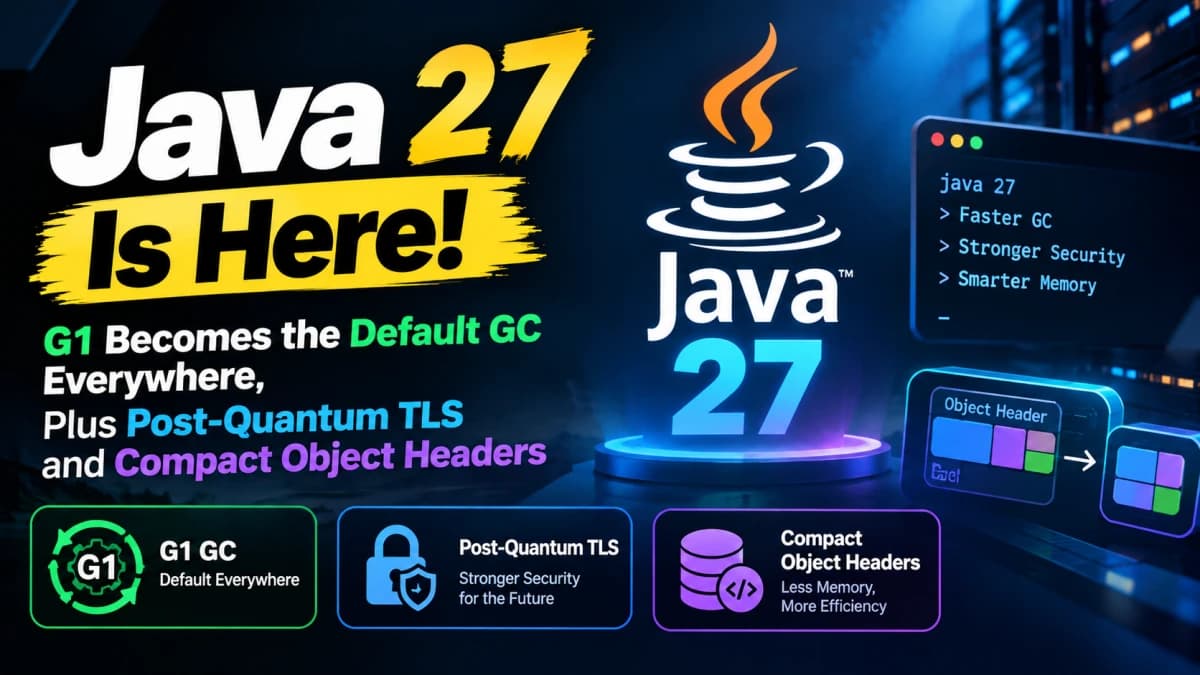
Oracle announced the general availability of JDK 27 on September 15, 2026. It is the 18th feature release delivered on time under Java's six-month cadence, and it brings a focused set of changes to performance, security, and the language itself.
What's new in Java 27
JDK 27 ships nine JEPs (JDK Enhancement Proposals), including four preview features and one incubator feature. The headline changes:
- G1 becomes the default garbage collector everywhere (JEP 523): Previously G1 was the default only on server-class machines. Now the JVM selects it by default in every environment, which makes GC behavior more predictable across laptops, containers, and servers.
- Post-quantum hybrid key exchange for TLS 1.3 (JEP 527): TLS 1.3 gains a hybrid key exchange designed to stay secure against future quantum attacks. This is a natural next step after the KEM API introduced in Java 21.
- Compact object headers by default: Smaller object headers mean lower memory footprint for object-heavy applications.
- JFR data redaction: Java Flight Recorder gets support for redacting sensitive data in recordings.
- More previews: Structured concurrency and pattern matching continue to evolve in preview, and the Vector API enters its twelfth incubation round.
Should you upgrade?
JDK 27 is a non-LTS release. Oracle will provide updates until March 2027, after which it is superseded by JDK 28. The current long-term support release is JDK 25, and the next LTS, JDK 29, is expected in 2027.
Our take:
- Learning and side projects: Go ahead and try JDK 27 to explore the new features, especially the previews.
- Production systems: Stay on an LTS release like JDK 25 unless you specifically need something from 27.
- Performance-sensitive apps: Test the G1 default and compact object headers in staging before rolling anything out.
Where to get it
Production-ready GPL binaries are available from Oracle, and builds from other OpenJDK vendors are following. The official JDK 27 page on openjdk.org lists the complete JEP set and release notes.
Java's steady six-month rhythm means the next release is already on the horizon. If you build on the JVM, keeping an eye on each release keeps future upgrades small and painless.
Stay ahead of artificial intelligence & systems code.
One email a week with the biggest AI and dev news. No spam. Unsubscribe anytime.