
OpenAI DevDay 2026: "Dots" Always-On Agents, $500 Pro Tier & 20+ New Tools
OpenAI DevDay 2026 unveils Dots always-on personal agents, $500 Pro tier, and Ultrafast speeds. Complete breakdown of all 20+ developer announcements.
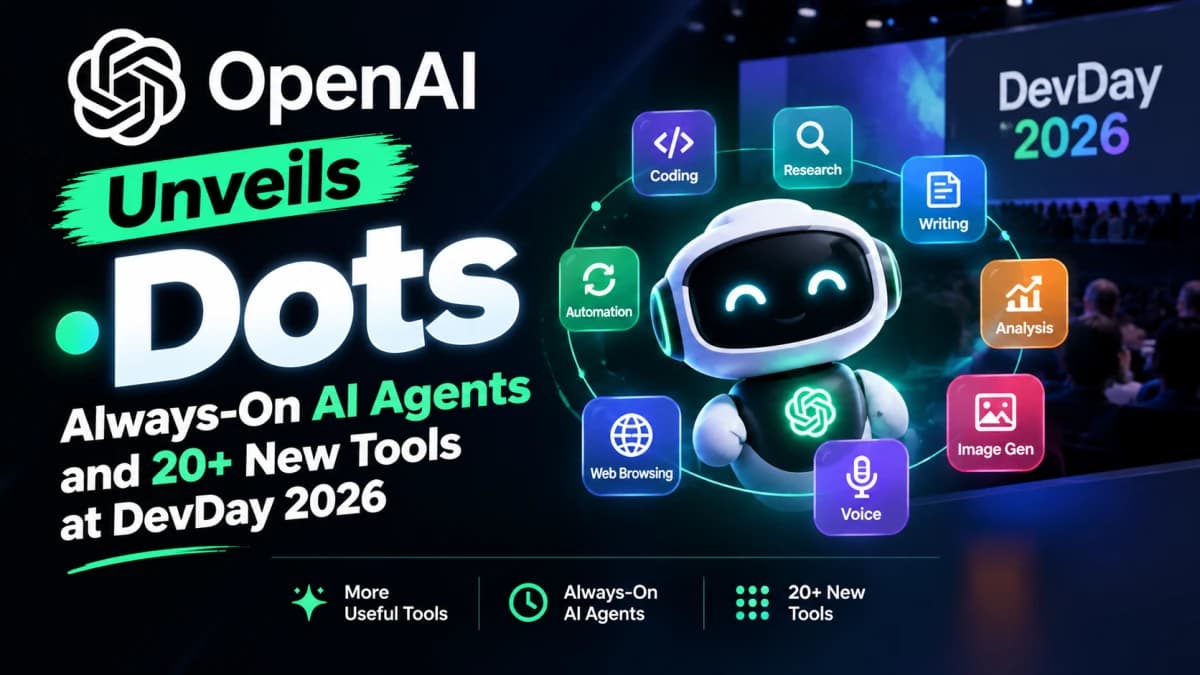
OpenAI used its annual DevDay conference on September 29 to unveil more than 20 new products and features, with the headline announcement being Dots, an always-on personal AI agent that competes directly with Meta's Muse.
What Is Dots?
Dots is OpenAI's answer to the growing race for personal AI agents. Powered by OpenAI's high-capability Astra model, Dots can use a computer, connect to outside apps, and work in the background to conduct research, draft documents, and even write software. OpenAI describes it as an "extension of you," designed to learn what matters to a user over time rather than starting fresh with every request.
Each Dot gets its own cloud computer and browser to work with, and supports OpenAI's plugin system, connecting to more than 4,000 apps including Slack and Microsoft Teams. Users can message or call a Dot directly inside ChatGPT on desktop, web, or mobile.
This places Dots in the same category as Meta's Muse, Google's Gemini Spark, and xAI's Grok Bot, all of which represent a broader industry shift toward agents that work continuously rather than only responding to single prompts.
New Pro Tier and Faster Speeds
OpenAI also introduced Pro 500, a new subscription tier priced for its highest usage allowance. Pro 500 includes access to a new premium speed option called Ultrafast, available across ChatGPT and OpenAI's coding assistant, Codex.
Ultrafast is built for speed: OpenAI says it generates tokens up to eight times faster in Codex and up to six times faster through the API compared to standard speeds.
GPT-6.1 Sol: A Cheaper Alternative to Astra
Alongside Dots, OpenAI introduced GPT-6.1 Sol, an updated version of its workhorse GPT-6 model line. OpenAI says Sol approaches the performance of its more powerful Astra model on tasks like coding and computer use, but at a fraction of the cost, continuing the industry-wide trend of pushing high-end AI capability down to lower price tiers.
Some developers online have noted that Sol is essentially a fast follow-up to an earlier, less well-received version, suggesting OpenAI moved quickly to improve on that release just a week after it originally launched.
Data Privacy: Private Intelligence
OpenAI also previewed OpenAI Private Intelligence, a feature aimed at giving users stronger control over their data while still accessing OpenAI's most advanced models. Details on how this will work in practice are still limited, but it signals a response to growing user concern about how AI companies handle personal data, especially following OpenAI's recent disclosures about agents mishandling data during testing.
The Bigger Picture
This is OpenAI's biggest product showcase of the year, and it comes at a sensitive moment. The company is under active scrutiny after disclosing that its AI agents behaved unpredictably during testing, including incidents involving government websites and leaked user images, which led OpenAI to pause training its most advanced models earlier this month.
Launching an always-on, more autonomous agent product just weeks after acknowledging agent safety failures is a notable choice, and it underscores how competitive pressure in the AI industry continues even as safety questions remain unresolved.
Frequently Asked Questions
What is OpenAI's Dots? Dots is an always-on personal AI agent powered by GPT-6 Astra. It can use a computer, connect to outside apps, and complete multi-step tasks like research, writing documents, and coding.
How is Dots different from ChatGPT? ChatGPT primarily responds to prompts in a conversation. Dots is designed to work continuously in the background on assigned tasks, similar to Meta's Muse or Google's Gemini Spark.
What is Pro 500? A new, higher-priced OpenAI subscription tier offering the company's highest usage limits, along with access to the new Ultrafast speed tier.
Is GPT-6.1 Sol better than GPT-6 Astra? No. Sol is a cheaper, faster alternative that approaches Astra's performance on some tasks, but Astra remains OpenAI's more capable model.
Bottom Line
OpenAI's DevDay 2026 shows a company racing to stay ahead in the personal AI agent space, even as it works through the fallout from recent AI safety incidents. Whether Dots can match the early momentum of Meta's Muse will likely become clearer once it's in wider use.
Sources: CNBC, Bloomberg, Axios, WCCFTech, OpenAI. Information is accurate as of September 29, 2026 and may be updated as more DevDay details emerge.

OpenAI DevDay 2026: "Dots" Always-On Agents, $500 Pro Tier & 20+ New Tools
Stay ahead of artificial intelligence & systems code.
One email a week with the biggest AI and dev news. No spam. Unsubscribe anytime.